A little clarity
Start an ear jewellery edit with the pieces you wear most, then consider scale, spacing and a clear focal point. Styling an existing collection is a separate decision from choosing jewellery for a fresh piercing.
An ear jewellery collection does not need to be large to feel personal. Often, the most considered combinations begin with one much-loved piece and a little restraint around it. The aim is a collection that works with your style, rather than a set of unrelated purchases made one at a time.
This is a styling notebook for jewellery you can appropriately wear in existing, healed piercings. It is not a guide to changing a fresh piercing or choosing its initial jewellery. Those decisions belong in a conversation with your piercer.
Take stock before adding more
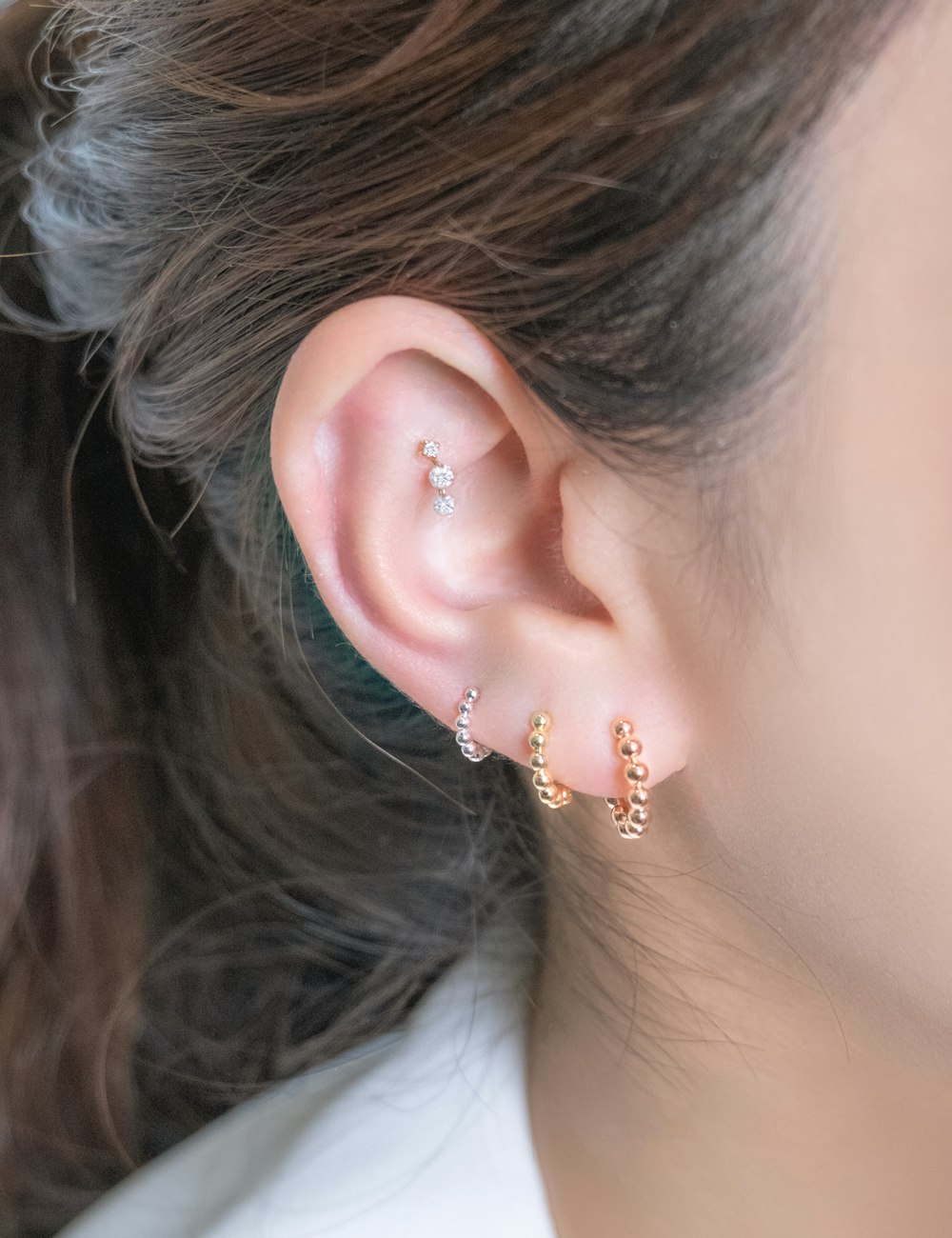
Lay out the pieces you reach for regularly and put occasional favourites beside them. Notice what they share: a particular metal tone, a soft curve, a small stone or a clean geometric shape. These repeated details are the beginning of your own visual language.
Then look at what stays in the box. It may be beautiful but too prominent for everyday wear, or it may simply belong to a different mood. You do not need every piece to work in the same combination.
Choose one point of attention
A focal point gives the rest of the arrangement something to relate to. It might be a slightly larger hoop, a meaningful charm or a brighter stone. Let surrounding pieces sit more quietly so the eye has somewhere to settle.
A useful exercise is to imagine the arrangement in silhouette. If every element has the same visual weight, try removing one rather than adding another. Space can be part of the composition.
Think in scale, not matching sets
Pieces do not need to be identical to feel connected. Similar proportions, a repeated finish or a shared curve can bring different designs together. A gradual change in scale can feel softer than a sudden jump between tiny and oversized pieces.
There is no fixed rule that both ears must mirror each other. An asymmetric arrangement can still feel balanced when it repeats one or two details. Use a mirror and look at the whole effect, including your glasses, hairstyle and other jewellery.
Make room for everyday life
A styling choice should make sense beyond a photograph. Think about your usual workwear, the accessories you wear around your ears and how much visual detail feels comfortable for you. Note anything you want to ask a piercer about before making changes.
Comfort, fit and suitability take priority over a moodboard. Decorative appearance alone does not tell you whether a piece is appropriate for a particular piercing. Ask for advice about your individual jewellery rather than assuming that two similar-looking pieces are interchangeable.
Build a small collection in chapters
Try naming three combinations: everyday, dressed-up and minimal. You may find the same core pieces work across all three, with just one change. That gives future purchases a purpose and helps you avoid buying several pieces that do the same job.
If you are considering a new piercing as part of a longer-term look, bring your styling ideas to a conversation at our Sittingbourne studio. Our ear and body piercing guide covers appointment questions; the collection itself can develop at your own pace.
Do both ears need to match?
No. Matching is a style preference. An asymmetric look can feel cohesive when it repeats a finish, shape or proportion.
Can I use a styling guide to choose jewellery for a fresh piercing?
No. Initial jewellery and any changes during healing need individual advice from your piercer. This article concerns styling an existing collection, not aftercare.
How can different jewellery pieces feel cohesive?
Repeat one or two visual details, such as a finish, curve or proportion. A shared detail can connect different pieces without requiring an identical set.